
Australia’s 2026/27 Water Sector Salary Guide: A Big Claim, and the Work Behind It
Oct 11, 2026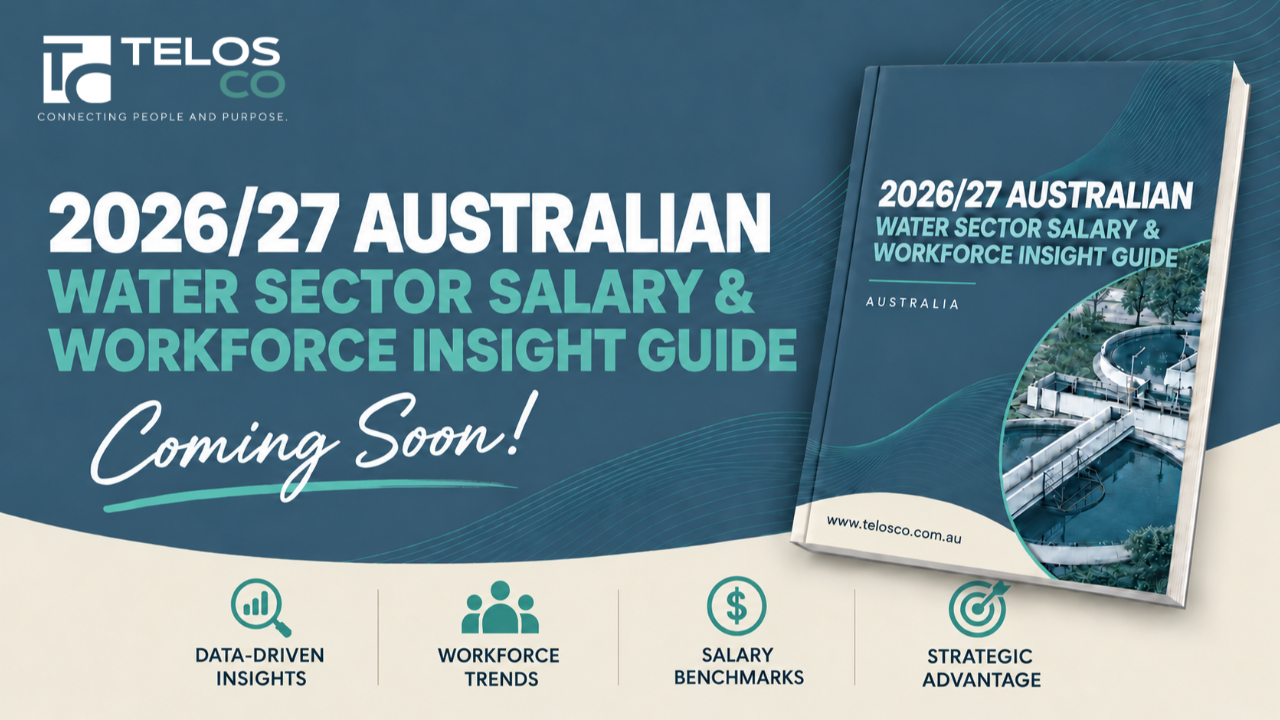
Last week, I made a cheeky claim: Australia’s best and most in-depth water-sector salary guide would be ready soon.
The response was immediate. People asked for it. A few quite reasonably pointed out that “best” is a big word.
It is. So here is the more useful question: what does a salary guide need to understand before it can say anything meaningful about pay in the water sector?
A title alone is not enough. “Engineer” can mean a different kind of work, accountability and scarcity depending on the assets, projects and places around it. A number without that context may be tidy. It may also be misleading.
That is why the 2026/27 Australian Water Sector Salary & Workforce Insight Guide has been built around the work itself.
A guide that goes narrow enough to be useful
The current guide covers 138 distinct job titles and role types across 14 sections. Using a narrow test for roles tied directly to water assets, treatment, water quality and resources, sewerage, dams or irrigation, about 26 are water-specific or strongly water-focused. The remaining 112 are transferable roles benchmarked in a water-sector context.
That breadth is deliberate. Water utilities and the organisations that design, build and maintain their assets rely on much more than the roles with “water” in the title. Their work depends on civil and structural engineers, project managers, construction leaders, electrical and mechanical specialists, controls engineers, commercial teams, data professionals, people and finance leaders.
The guide brings those roles into one view, alongside functions that are unmistakably shaped by the sector: treatment and process engineering; water quality; hydrology and network modelling; water allocations; dam safety; irrigation; operations and field maintenance.
To our knowledge, this guide features the most industry-specific roles ever included in an Australian water-sector salary guide. It is a substantial claim. The detail behind it is 14 sections of work that the sector actually needs done.
Register your interest for first access to the guide.
A salary figure needs its conditions attached
A benchmark is only useful when you know what it includes. The guide’s figures are annual base salaries in Australian dollars. They exclude the 12% superannuation guarantee, short-term incentives, vehicle allowances, overtime and on-call penalties.
They also need to be read against the market in which the work is being done. A standard role in a regional council or smaller irrigation scheme may sit below a metropolitan benchmark. A specialist role in an isolated location can move the other way when an employer has to compete for a scarce capability. Professional registration, the scope of sign-off, asset complexity and the stage of a project can all change what a role is worth.
The point is not to turn every salary conversation into a formula. It is to make the assumptions visible, so employers and professionals can ask better questions about the work, the location, the level of responsibility and the whole package.
The conversation behind the numbers
Salary review season often makes a benchmark feel like an answer. In practice, it is a place to begin.
For a professional, the guide can help frame a conversation about experience, responsibility and the next step in a career. For an employer, it can inform workforce budgets, succession planning and the practical question of whether a role is positioned to attract or retain the capability it needs.
That conversation reaches beyond pay. The broader guide considers career progression, early-career development, transferable experience, regional and remote opportunities, retention, succession and the ways changing technology may reshape work.
Its closing discussion looks at digital water: the meeting point between established engineering and data capability. As utilities respond to ageing networks, climate volatility and workforce pressure, tools such as IoT telemetry, GIS, AI and machine learning, digital twins, computer vision and edge computing are opening new applications. The technology matters. So does the judgement of the engineers and operators accountable for safe, reliable systems.
A claim you can test
I am happy to stand behind the claim that this is the most in-depth guide of its kind I have seen. I also know that a claim is only as strong as the work beneath it.
So, rather than ask you to take my word for it, we are giving people the chance to see the guide for themselves as soon as it is released. Register your interest and we’ll let you know when it is ready, so you can decide whether the detail earns the description.
Register your interest in the 2026/27 Australian Water Sector Salary & Workforce Insight Guide.
The guide is being prepared for professionals, employers and leaders who want a clearer view of the people and capability behind Australia’s water infrastructure. If it gives the sector a more useful way to talk about pay, responsibility and what comes next, it will have done its job.